

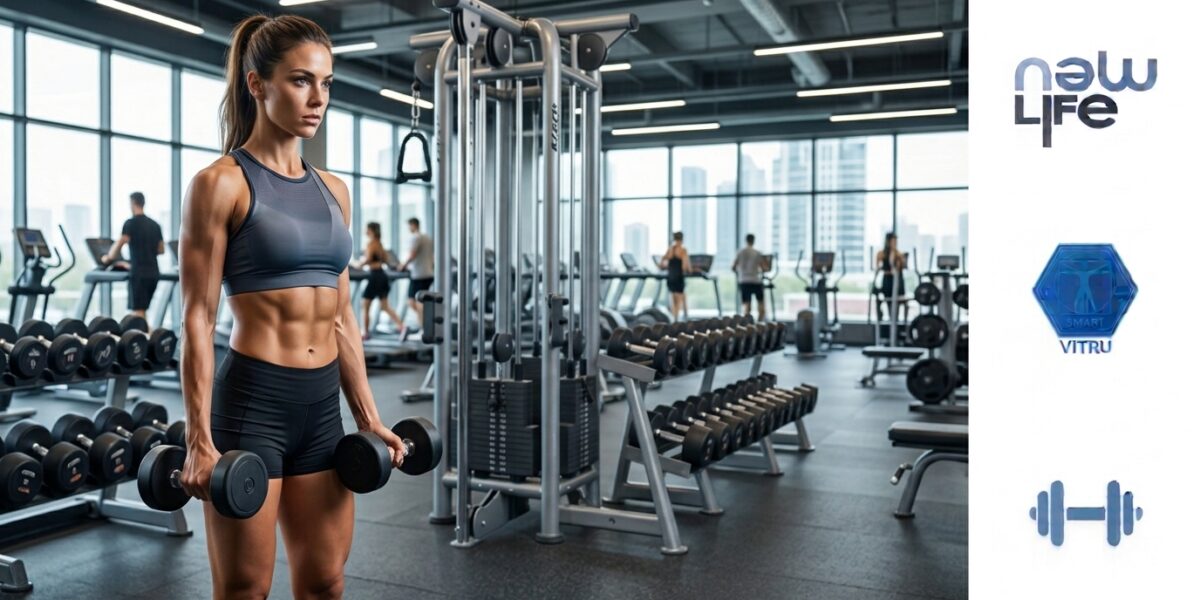
Walk into any gym, and you will likely notice a common pattern: lifters bouncing randomly from machine to bench without a clear plan, relying purely on instinct. However, modern exercise science shows that muscle hypertrophy requires structured programming, smart exercise selection, and a basic understanding of biomechanics.
Compound (Multi-Joint) vs. Isolation (Single-Joint) Exercises
To design an effective workout, you first need to categorize exercises based on how many joints are involved in the movement:
- Compound (Multi-Joint) Exercises: These require the coordinated movement of two or more joints and recruit large muscle groups simultaneously. Classic examples include squats, deadlifts, bench presses, overhead presses, pull-ups/chin-ups, and dips.
- Isolation (Single-Joint) Exercises: The movement occurs around a single joint, targeting a specific muscle with precision. This category includes leg extensions, lateral raises, barbell bicep curls (movement strictly at the elbow), and tricep pushdowns or extensions.
Free Weights, Machines, or Cables?
Choosing your equipment isn’t about which tool “builds” more muscle, but rather how mechanical tension is distributed and how much stability is required:
- Free Weights (Barbells, Dumbbells): Demand high neuromuscular coordination and heavily engage stabilizer muscles. Resistance relies on gravity, which creates points of peak and minimal tension within the same repetition.
- Fixed-Path Machines: Lock the movement into a specific plane, removing the need for balance. This external stability allows you to push the target muscle close to muscular failure safely.
- Cables: Serve as the sweet spot between free weights and machines. They offer a free path of motion (requiring bodily control) while maintaining constant, uninterrupted mechanical tension throughout the entire range of motion—even at angles where free weights let the muscle “rest.”
The Ideal Exercise Order in a Workout
Scientific literature supports sequencing exercises from the most neurologically demanding to the least:
- Start of the Workout – Primary Compound Movements (Free Weights / Bodyweight): Perform these first while your central nervous system and energy stores are at their peak (e.g., squats, pull-ups, dips, or bench presses). Aim for heavier loads (3–4 sets of 5–8 reps) with full control during the negative (eccentric) phase and explosiveness during the positive (concentric) phase.
- Middle of the Workout – Secondary Compound Movements (Machines / Dumbbells / Cables): Exercises like leg presses, machine presses, or seated cable rows. These add high-quality training volume (3 sets of 8–12 reps) without overly taxing your lower back or central nervous system.
- End of the Workout – Single-Joint / Isolation Movements (Cables / Machines / Dumbbells): Used to deliver extra hypertrophy stimulus and continuous tension to lagging muscles or those not fully maximized during compound lifts (e.g., leg extensions, bicep curls, cable chest flyes). These are typically performed in higher rep ranges (3 sets of 10–15 reps) close to failure.
For Advanced Lifters: Closed vs. Open Kinetic Chain (CKC & OKC)
Beyond the number of joints, biomechanics classifies exercises based on whether your limb (hand or foot) is fixed or moving freely in space:
- Closed Kinetic Chain (CKC) Exercises: The distal limb (feet or hands) remains fixed against a stationary surface (the floor, a pull-up bar, parallel bars), and the body moves around it. Examples include squats, lunges, push-ups, dips, and pull-ups. They promote high joint stability through muscular co-contraction and carry over directly to functional movement.
- Open Kinetic Chain (OKC) Exercises: The distal limb moves freely in space while the torso or proximal body remains stationary. Examples include leg extensions, bicep curls, bench presses, and lat pulldowns. They allow for strict muscle isolation and targeted strengthening at specific joint angles.
The Science Behind “Pre-Exhaustion”
Pre-exhaustion is an advanced technique that is often misunderstood. Its true purpose is to fatigue the primary target muscle using an isolation exercise right before a compound lift.
- Correct Approach: Performing chest flyes (pec-deck or cables) immediately before bench pressing so the pectorals reach fatigue first.
- Incorrect Approach: Fatiguing synergistic (assisting) muscles—like the triceps—before bench pressing, as they will give out early and prevent the chest from receiving an adequate growth stimulus.
The Core Pillars of Muscle Growth
Training is only the trigger. Actual muscle protein synthesis happens during recovery, which relies on three non-negotiable factors:
- Progressive Overload: Gradually increasing weight, repetitions, or execution quality over time.
- Nutritional Support: Adequate daily protein intake (roughly 1.6–2.2g per kilogram of body weight) spread throughout the day, paired with carbohydrates to replenish muscle glycogen.
- Quality Sleep: 7–9 hours of sleep per night for optimal hormonal regulation and nervous system recovery.
Conclusion
Transforming your physique isn’t a matter of luck, nor does it require endless hours of aimlessly wandering between gym machines. When you understand how each exercise functions, when to use free weights, machines, or cables, and how to sequence your movements, every single set serves a clear purpose. Pair this knowledge with consistency, proper nutrition, and quality sleep, and let science work in your favor.