

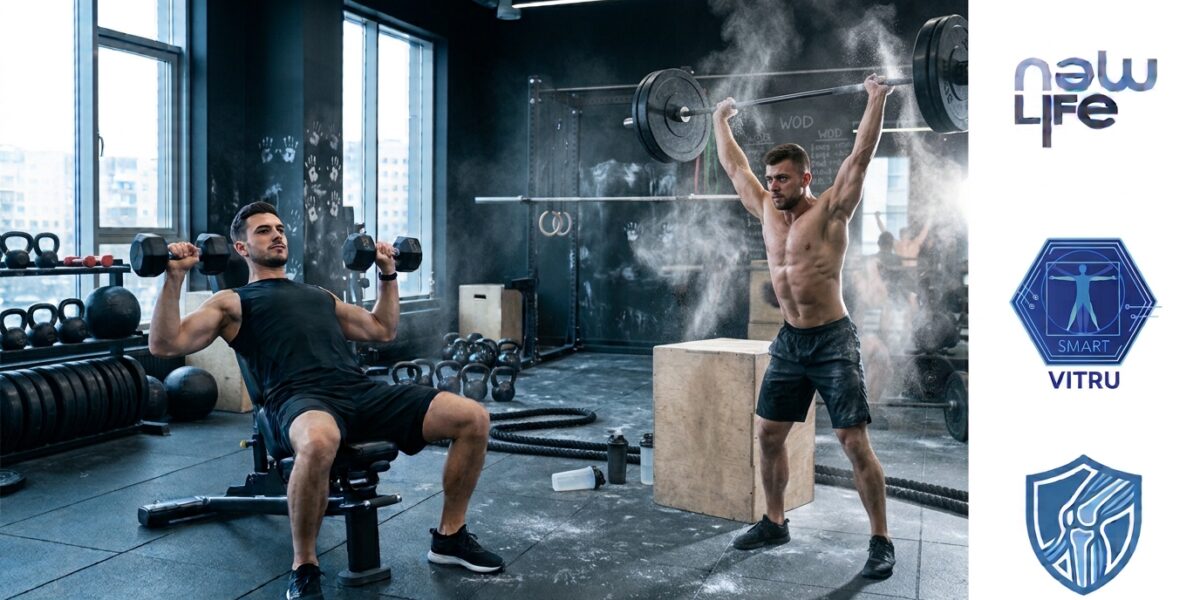
Wondering which training method builds muscle more effectively, boosts overall fitness, and protects your joints? Discover what exercise science reveals when comparing traditional gym workouts with CrossFit.
In recent years, the debate between Traditional Resistance Training (Fitness) and CrossFit has been a hot topic among gym-goers and fitness professionals alike. While both methods improve physical conditioning, they differ fundamentally in training philosophy, joint stress, and how they engage the muscular system.
Let’s look at what comparative scientific studies show across four key areas:
1. Muscle Hypertrophy and Strength
When it comes to increasing muscle strength and size, comparative studies (such as Nataraj et al., 2023 and Monarita & Singh, 2024) show that both methods yield similar benefits for beginners during the initial weeks of training.
However, at an intermediate or advanced level, traditional strength training holds a clear advantage for muscle hypertrophy and symmetry. This is because it allows for:
- Controlled progressive overload (precise, incremental weight increases).
- Targeted muscle isolation and corrective exercises.
- Adequate rest intervals between sets, maximizing mechanical tension without interference from cardiovascular exhaustion.
2. Cardiovascular Endurance & Metabolic Stimulus
In terms of aerobic and anaerobic endurance, a systematic review (Claudino et al., 2018) notes that CrossFit—due to its high intensity and minimal rest periods (WODs)—creates a strong metabolic demand, simultaneously improving VO₂ max and muscular endurance. In traditional fitness, the same result is achieved by combining resistance training with targeted cardio or HIIT sessions, but with far better fatigue management.
3. Injury Rates: The Revealing Data
When researchers compared CrossFit directly with traditional weight training (Elkin et al., 2019 – Orthopaedic Journal of Sports Medicine, examining 411 participants), the findings revealed significant differences:
- CrossFit participants were 1.3 to 2.26 times more likely to sustain an injury compared to those performing traditional resistance training.
- They were nearly twice as likely (1.86x) to seek medical attention for an injury.
- A study by Da Costa et al. (2022) found that a competitive training environment (working out against the clock or for leaderboard rankings) increases injury risk fivefold, as speed often compromises proper form.
4. The Crucial Difference: Prime Movers vs. Deep Stabilizers
Beyond the statistics, biomechanics explains why these injuries occur (most commonly in the shoulders and lower back):
- CrossFit focuses primarily on large, superficial muscle groups, performing explosive, complex movements (Olympic lifts, overhead presses, gymnastics) under high fatigue and time pressure. When small deep stabilizer muscles—such as the rotator cuff, transversus abdominis, and gluteus medius—are neglected, joints are left vulnerable to heavy loads.
- Modern Fitness training allows for comprehensive joint protection: it combines foundational compound lifts with targeted strengthening of your small stabilizer muscles, building a physique that isn’t just strong, but resilient over time.
Comparison Summary
| Criteria | Traditional Fitness (Strength Training) | CrossFit |
|---|---|---|
| Primary Goal | Muscle hypertrophy, strength, symmetry, joint longevity | General physical preparedness, high-intensity endurance, competition |
| Execution Pace | Controlled, prioritizing strict technique | High speed, often performed against the clock |
| Deep Stabilizers | Targeted strengthening & imbalance prevention | Often neglected due to focus on large compound movements |
| Injury Risk | Low (when performed with proper guidance) | 1.3x – 2.26x higher (primarily shoulders & lower back) |
Conclusion: Which Should You Choose?
If your goal is long-term health, body sculpting, building strength without unnecessary risk, and protecting your joints, structured Fitness training is the safest and most scientifically controlled choice. On the other hand, if you enjoy the intensity and variety of CrossFit, make sure to leave the stopwatch behind and incorporate dedicated stability drills into your routine.
References: Elkin et al. (2019), Orthopaedic Journal of Sports Medicine | Da Costa et al. (2022), Clinics | Claudino et al. (2018), Sports Medicine – Open | Nataraj et al. (2023).