
Proprioceptive Neuromuscular Facilitation (PNF) is a method used by therapists and strength coaches to train or retrain motor control. It is a dynamic approach to assessing and rehabilitating neurological and musculoskeletal dysfunctions, with a particular emphasis on the core.
The goal of the PNF method is to facilitate movement and improve an individual’s functional capacity. Peak performance is achieved when muscles work together in a complementary manner to produce harmonious movement.
Three-Dimensional Exercises
In practice, the method is applied through three-dimensional movement patterns that simultaneously combine flexion or extension with rotation and lateral flexion around the neutral position of the core.
The Impact of Exercises on Motor Learning
Strength coaches often use specialized exercises to activate multiple muscles simultaneously. However, this does not necessarily increase the trainee’s functional capacity, focusing instead on improving coordination. These exercises do not always follow the proper sequence of muscle group activation, but rather emphasize the simultaneous recruitment of multiple motor units and muscles.
Conventional models focusing on motor control training present it as a continuous process of progressive learning. In other words, a beginner progresses through sequential phases: cognitive, associative (recall), and autonomous (automation).
According to Schmidt’s Schema Theory, motor learning is a process of recall and recognition. The learning of motor schemas arises from the storage of sensory information (kinesthetic, proprioceptive, visual, and vestibular). Cognitive factors are essential for assimilating this information and determining the appropriate movements and postures at any given moment.
The PNF technique places the body in functional positions that replicate the movements of athletic skills. This multi-planar movement also helps maximize the intake of sensory stimuli.
Once a goal is identified, the brain combines individual movements to form a skillful action. Through practice, this movement becomes automated, allowing a voluntary action to be performed automatically without the need for preparatory thought.
Example: Consider a young basketball player. At first, intense concentration and effort are required. After years of practice and games, the player no longer thinks about the mechanics of taking a shot, but simply recalls the motor pattern and executes it automatically.
By the same principle, PNF exercises allow automatic neuromuscular programming to develop faster compared to conventional methods based on isolation exercises. Displacement, coordination, acceleration, and deceleration are not viewed separately, but as a harmonious whole. The brain recognizes basic movement patterns and “facilitates” the body in executing them, increasing performance and significantly reducing the learning time for new athletic skills.
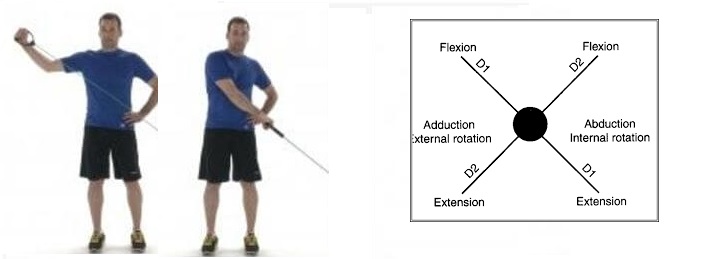
Facilitating movements are diagonal and spiral in nature, closely resembling movements found in sports and daily life. Diagonal spiral movements fully align with the anatomy of the skeletal system, joints, and ligaments, while remaining in complete harmony with the topographical alignment (origin – insertion) and structural characteristics of the muscles.
Diagonal Movement Exercise Program
Diagonal chops and lifts are multi-planar exercises (across all three planes of motion) that utilize diagonal spiral movements of the upper limbs, shoulders, core, hips, and lower limbs. They are typically performed from a standing position, although they can also be executed from a lunge, seated, or kneeling position to refine technique.
- Standing Position: This is the most demanding of the four variations, as it creates a closed kinetic chain in the lower limbs and requires maintaining a neutral position of the lumbar spine.
- Spinal Protection: Maintaining a neutral spine relies on the active core stabilization system, avoiding stress on the ligaments and intervertebral discs. Diagonal exercises create controlled, transferred eccentric loading, protecting the spine from overload or compression.
- Equipment: High or low pulleys (used directly or with a bar, single rope, or double rope) provide resistance for dynamic movement, while medicine balls can be utilized for plyometric applications.
Note on Symmetry: It is particularly important to identify any strength asymmetries between the right and left sides of the body and strive to balance them, even if the trainee’s sport or activity favors one side.
- Diagonal Chop: Involves (a) a pulling action followed by a pushing action of the upper body, (b) core stabilization across all three planes (flexion, rotation, and lateral flexion), and (c) center-of-gravity transfer for force production and dynamic balance.
- Diagonal Lift: Performed from a stable stance. The trainee stands at a 45° angle to the cable machine with an open base of support (e.g., left foot forward) and the lumbar spine in a neutral position.
Progression
Once the trainee becomes familiar with the diagonal exercise program, the difficulty level can be increased by raising the stability demands. The body’s biomechanical function must be strictly monitored at every stage of progression, as true improvement only comes through proper technique. If fatigue alters technique during the exercise, the set must be terminated immediately.
The progression of positions is structured as follows:
- Seated Position: Does not require activation of the hips and lower limbs, making it the safest option and the first preparatory stage.
- Kneeling Position: Involves limited activation of the leg and hip muscles compared to standing, serving as an intermediate preparatory stage.
- Standing Position: Requires full stabilization of the entire kinetic chain.
Preparatory phases are progressively adjusted according to intensity, range of motion, and the required degree of core stability.
Conclusion
Integrating Proprioceptive Neuromuscular Facilitation (PNF) and three-dimensional diagonal exercises into a training routine bridges the gap between muscular strengthening and true functional movement. Whether your goal is to enhance athletic performance, rehabilitate, or prevent everyday injuries, proper neuromuscular training is the key to a strong, balanced, and resilient body.
At New Life, our specialized trainers design personalized workout programs based on modern biomechanical principles, guiding you safely through every stage of your progress.